Etosha National Park
22,270 km² centered on a salt pan visible from space, where wildlife gathers at waterholes rather than being tracked across the savanna.
Etosha covers north-central Namibia across 22,270 km², an area roughly the size of Slovenia. The park is organized around a salt pan of 4,800 km², an ancient dried-up lake dating back approximately 16,000 years, whose white crust reflects light so intensely it can be spotted from low orbit. The name means "great white space" in Oshiwambo, and most of the wildlife concentrates on the southern fringe of the pan, where underground springs surface.
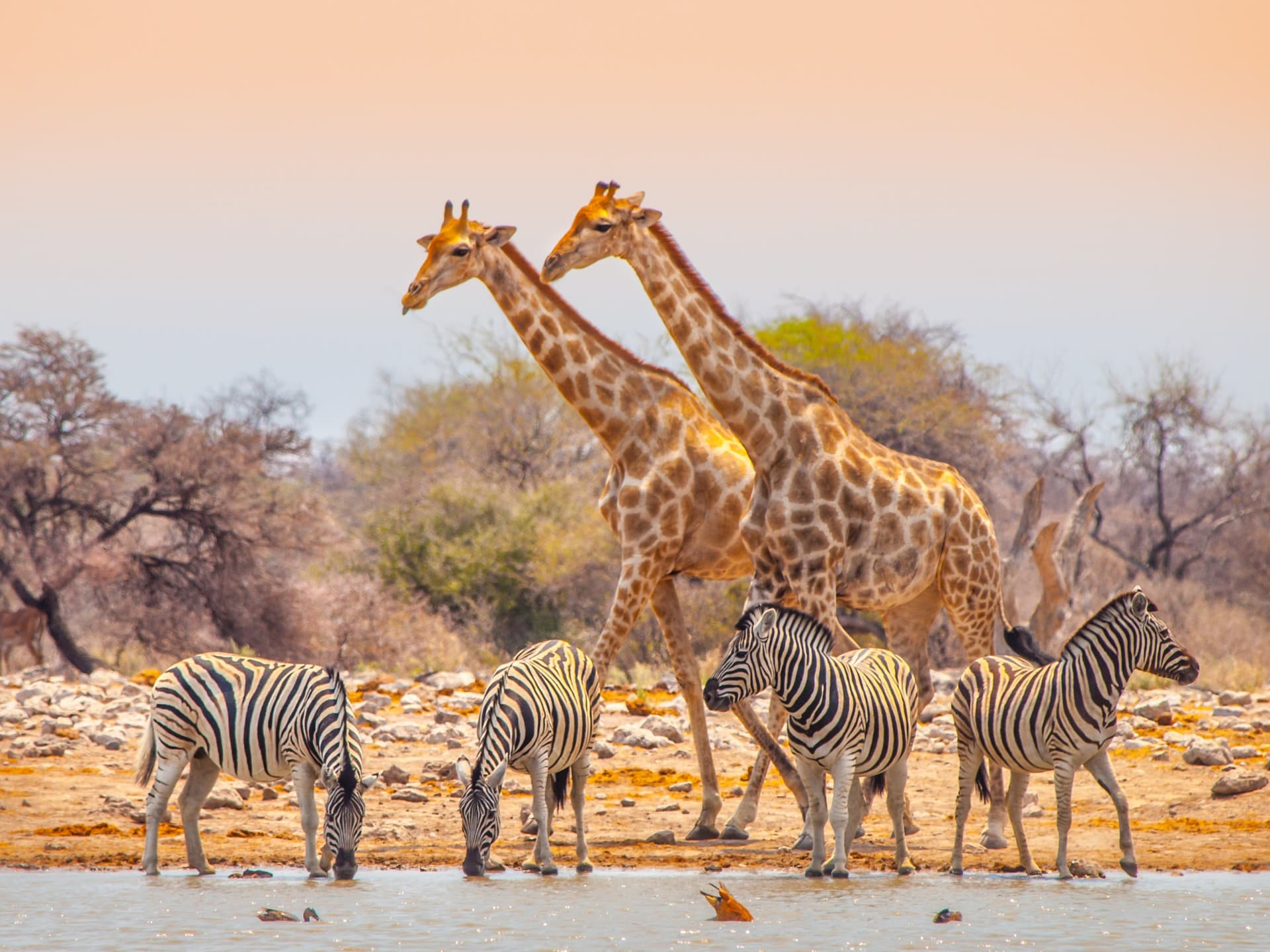
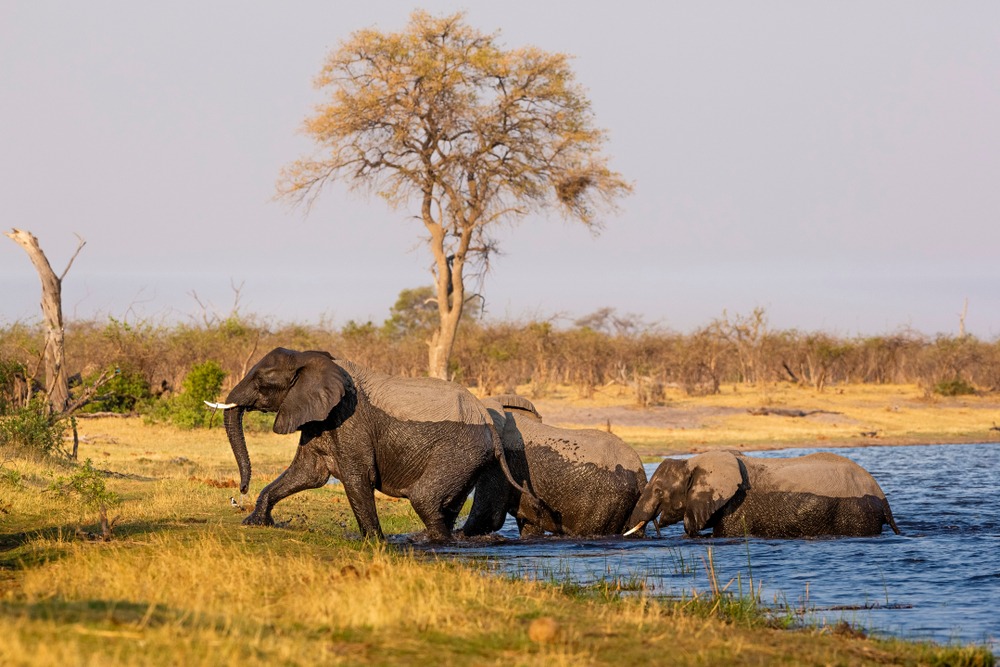
The observation strategy differs markedly from East African parks. Here, there is no vehicle tracking across open savanna: the tracks remain accessible to regular touring vehicles, and visitors position themselves at waterholes—natural or artificial—where wildlife comes to drink throughout the day. This fundamentally transforms the rhythm of the safari. You station yourself at Okondeka, Nebrownii, Olifantsbad or Goas, sometimes for an hour or two, observing the rotation of species: Burchell's zebras in the morning, oryx at midday, elephants in late afternoon.
Three historic camps structure the park from west to east. Okaukuejo, at the southwestern entrance, houses the administrative headquarters and the most reliable waterhole for black rhinos in the evening. Halali, centrally located, serves as a practical base for exploring secondary pans and benefits from a waterhole on a rocky outcrop. Namutoni, to the east, occupies a restored 1903 German fort, close to Klein Namutoni waterhole where leopards pass regularly. Each camp has a waterhole illuminated continuously at night, accessible on foot from the bungalows, allowing you to observe black rhinos, brown hyenas and sometimes lions without a vehicle.
The fauna comprises 114 mammal species, including the desert elephant of the north, springbok, eland, gemsbok, Angolan giraffe, as well as approximately 300 black rhinos—one of southern Africa's most stable populations. Felines are spotted mainly around the Halali and Okaukuejo camps. For birdwatchers, the pan attracts tens of thousands of lesser and greater flamingos during the wet seasons, when a thin layer of water covers the salt and triggers cyanobacteria production, their primary food source.
The human landscape of the park is evident at its periphery. To the south, the Outjo region and Kamanjab farms mark the transition toward commercial ranches and private concessions (Ongava, Onguma) bordering the park's fences, offering night safari—prohibited within Etosha itself. To the north, the densely populated Ovambo country borders the park at King Nehale Gate, opened in 2003, providing access to Owamboland from Namutoni. This gate significantly improves logistics for travelers continuing toward the Caprivi.
The management of artificial waterholes, fed by boreholes since the 1950s, remains debated among Namibian ecologists: it sustains dense wildlife but has altered historic migration patterns. Our team believes understanding this context is essential to reading the landscape properly. Etosha is not "untouched" nature but a managed ecosystem, and that is precisely what makes it such an exceptionally readable observation terrain for the traveler—provided you devote sufficient time to it.
Must-see experiences
Okaukuejo waterhole at nightfall. The camp's waterhole, lit by softened floodlights, attracts black rhinos almost every evening between 8 p.m. and 11 p.m. You settle on the stone wall, in silence, sometimes fewer than fifty feet from the animal.
The salt pan from Etosha Lookout. At the end of a 12 km track north of Okaukuejo, you access the pan's surface on foot. A 360° view of the cracked white crust, utterly without relief, with a distinctive acoustic silence.
Namutoni Fort. A former German Schutztruppe post captured by the Ovambos in 1904 and later reconstructed, the fort now serves as the heart of the eastern camp. The first-floor terrace overlooks Fischer's Pan.
Concentration at Goas waterhole. Between Halali and Namutoni, this waterhole attracts up to six species simultaneously at mid-morning in the dry season: giraffes, zebras, blue wildebeest, oryx, springbok and elephants.
Ongava private concession to the south. Adjoining the park's southern fence, this 30,000-hectare reserve permits walking safaris and night drives—two activities forbidden within Etosha. It complements the experience with nocturnal predator behavior.
When to visit
The dry season from May to October remains the most efficient window for wildlife viewing. Temporary waterholes in the savanna disappear and fauna concentrate at permanent water sources, which heightens sightings. Morning temperatures drop to 37–41°F in June and July, with daytime highs between 72–79°F: bring a fleece and hat for the early morning game drive. September and October are the hottest months before the rains, reaching up to 95°F in the afternoon, and vegetation is at its sparsest, maximizing visibility.
The wet season from November to April transforms the park. Rainfall occurs primarily in January–February, with annual totals of 12 to 18 inches concentrated in brief thunderstorms. Wildlife disperses because water is abundant everywhere, sightings become more unpredictable, but landscapes green and newborn springboks and wildebeest attract predators. This is also peak season for flamingos on the pan when a thin water layer forms. Our team discourages first-time visitors from going in February–March but recommends it for bird photographers.
Practical advice
We recommend a minimum of three nights, ideally four, split between two different camps to cover both western (Okaukuejo) and eastern zones (Halali or Namutoni). The park spans 125 miles east to west, and doing round trips from a single camp wastes unnecessary time. Access is by road from Windhoek (approximately 280 miles, 5 hours via B1 then C38) or by charter flight from Windhoek to private airstrips at Ongava or Mokuti near Namutoni. There is no commercial airport within the park.
Etosha pairs naturally with Damaraland to the west (Twyfelfontein engravings, desert elephants) over an additional 2–3 days, then with the Namib Desert further south for a classic 12–14 day itinerary. For travelers continuing toward the Caprivi and the northeast, the King Nehale Gate exit makes logical sense. Comfort levels range from self-drive camping to private concession lodges exceeding €600 per night. The park suits families with children from age 6 onward, contemplative travelers willing to station themselves at a waterhole for extended periods, and patient wildlife photographers. Less suited for those seeking hiking or physical adventure: Etosha is experienced from the vehicle or camp terrace.