Lüderitz
Lüderitz
German colonial architecture, a ghost town swallowed by sand, Cape fur seals, and a century-old lighthouse: Lüderitz, an extraordinary gem of southern Namibia.
Guardians of the past's remnants, Lüderitz and its surroundings resemble no other destination in the world. This small coastal town is located in southern Namibia. It is bordered by the Atlantic Ocean to the west and encircled by the Namib Desert.
Colonial architecture, an abandoned village, an ancient lighthouse, fresh fish and seafood, a sporting event—there is something for everyone to discover in Lüderitz.
The Town's History
The Nama people inhabited the region for centuries before the arrival of the first Westerners. The bay was later "discovered" by the Portuguese in 1487. They named it Angra Pequena. They established no lasting structures due to the inhospitable environment they deemed it to be.
Toward the end of the 19th century, a wealthy tobacco merchant showed interest in this part of the country. Adolf Lüderitz arrived at Angra Pequena and purchased land from a local Nama chief. He then had a harbor town built. The town was renamed in his honor around 1886.
Initially, the town was considered the country's main port, but it became increasingly inaccessible to vessels due to rough seas and rocky coastlines. Namibia's principal port was then relocated to Walvis Bay, and Lüderitz's maritime activities became limited primarily to fishing.
Lüderitz was the very first German town built in southwestern Africa. During the colonial period, many indigenous people were killed in the region.
The discovery of diamond deposits in its surroundings sparked the town's growth throughout the 20th century. However, this precious resource eventually ran dry. Mining operations were relocated further south, and many people left the area. The remnants they left behind remain visible today.
Lüderitz Today
Lüderitz is a blend of past remnants and modernity. There, colonial architecture buildings stand alongside recently constructed houses. Its roads are principally made of compacted earth and sand. The only paved road is Bismark Strasse, which leads to the harbor.
Its restaurants brim with seafood specialties, delighting culinary enthusiasts. Thanks to the vestiges present in the old town and its museum, it is very easy to delve into the past and discover the region's fascinating history.
Exploring Lüderitz
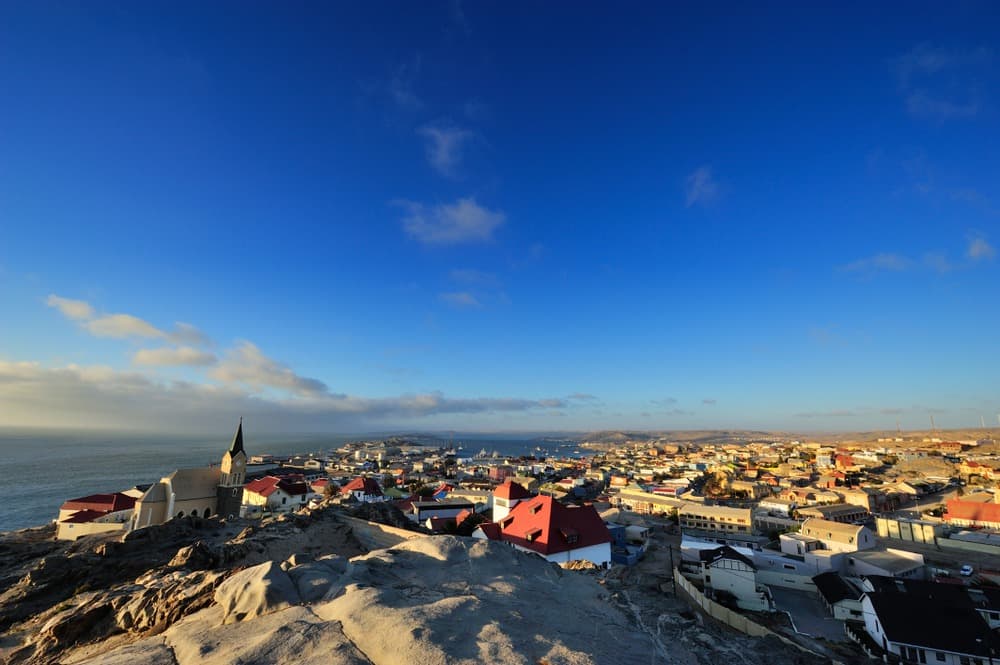
The landscape of Lüderitz is quite striking. Upon entering the town, one notices from a distance a wide variety of houses differing in size and architecture. The period buildings are arguably the most distinctive. In shades of blue, green, or orange, their architecture is either German colonial style or reminiscent of Portuguese colonial design. The scene is punctuated by a few trees planted here and there near residences. The atmosphere feels relaxed, far removed from life's troubles.
Observing the town as a whole, one notices that the houses appear randomly arranged. They give the impression of having long awaited visitors from afar. Leaving the jetty, one can follow a paved road where a few vehicles circulate. Among the houses of quite varied architecture, one notices from afar the famous Felsenkirche Lutheran church perched on the hillside.
Opposite it stands Lüderitz's most beautiful house, Goerke Haus. This white building with a red roof displays German colonial style on the outside. Its interior is equally surprising. The curves of the timber framing in the living room, dining room, and bedrooms evoke Art Nouveau, drawing heavy inspiration from nature. It is truly a beautiful place to visit.
One can deepen the journey into Namibia's past by visiting the Lüderitz Museum, the colonial church, the old post office, and the local railway station.
Local Wildlife
Lüderitz and its surroundings are also a haven for numerous animal species. Near the jetty, one can observe aquatic birds such as cormorants and turnstones. During a boat cruise, one may spot dolphins, whales, African penguins, black oystercatchers, and whimbrels on Halifax Island.
Heading west, along the Kolmanskop road, one may encounter flamingos. At Diaz Point, one can also encounter springboks, gemsboks, rare wild horses, ostriches along the way, and observe seals from a distance on seal island. Elisabeth Bay, another ghost town, is a meeting place for the famous Cape fur seals.
The Town of Kolmanskop
About ten kilometers south of Lüderitz lies the ghost town of Kolmanskop. It was founded in the early 20th century, some time after the discovery of a diamond deposit there. Houses, a hospital, library, school, theater, and bakery quickly emerged.
It was abandoned in 1956 when mining operations were relocated near the South African border. In the absence of human activity, the desert gradually reclaimed its rights and slowly buried what remained of the settlement under sand.
With a good guide, one can venture inside certain houses to see and understand the daily life of the era's inhabitants.
Diaz Point
Diaz Point sits on a peninsula approximately twenty kilometers from Lüderitz. It is arguably one of the region's most important historical markers. Around 1488, Bartolomeu Dias landed on Namibia's shores. The Portuguese explorer discovered the farthest point ever reached by his contemporaries in this part of the world. He erected a cross to mark his passage. A replica of this symbol is currently visible at Diaz Point.
The site also houses a 28-meter-high lighthouse painted in red and white. It was inaugurated around 1915 to guide ships arriving in Lüderitz Bay.
Lüderitz and its surroundings still hold many surprises for visitors. The natural arch of Bogenfels and the agate beach are among the wonders waiting to be explored.
Practical Information
From abroad, you can land directly at Windhoek International Airport, Namibia's capital. Regional flights are sometimes available to Lüderitz. If you prefer to appreciate the region's landscape up close, you can take a bus or train from the railway station.
When to Go?
The ocean current meets the desert's heat at Lüderitz. The climate there is therefore mild year-round. Temperatures range between 10 to 25°C. The warm season is considered the best time to visit the locality and enjoy the beach. It runs from November through April.
Want to discover this destination?
Our local advisors design your tailor-made trip.