Twyfelfontein
Twyfelfontein
A UNESCO site in Damaraland, Twyfelfontein preserves thousands of petroglyphs carved into sandstone rock, bearing witness to millennia of human occupation.
Inscribed on the UNESCO World Heritage list since 2007, the archaeological site of Twyfelfontein is home to one of the most significant concentrations of rock art on the African continent. Nestled in a valley flanked by red sandstone mountains, in the heart of Namibian Damaraland, it houses thousands of petroglyphs carved into rock over countless millennia.
Why visit Twyfelfontein
Twyfelfontein offers a rare testament to hunter-gatherer societies that roamed southwestern Africa for millennia. The site combines exceptional archaeological value, an eroded sandstone landscape characteristic of Damaraland, and wildlife adapted to the desert that can be observed in the surrounding areas. Allow 1 to 2 hours for a guided tour of the carved panels, longer if you wish to explore the region further.
An English-speaking guide is mandatory to explore the trails, allowing you to better decipher the animal figures, footprints and ritual scenes whose significance remains debated.
History of the site
The valley was first occupied by hunter-gatherers, considered the primary authors of the oldest engravings. For about the past 2,500 years, Khoisan-speaking populations, including ancestors of the present-day Damara, have frequented the place and left part of the works visible today.
Europeans settled in the region at the end of World War II. Under the apartheid regime, local farms were integrated into the Odendaal Plan; white settlers eventually left the valley in 1965, returning the space to Damara communities.
The petroglyphs were revealed to the scientific world by surveyor Reinhard Maack, also discoverer of the White Lady of the Brandberg massif. The first systematic studies were conducted by Rudolf Scherz from 1950 onwards: he documented over 2,500 petroglyphs distributed across 212 sandstone rocks and proposed in 1975 a subdivision of the site into 15 distinct sectors. Current estimates place the total number of engravings at approximately 5,000.
What to see on-site
The petroglyphs
The guided tour leads along the most remarkable panels. You can recognize giraffes, rhinoceroses, lions, ostriches and antelopes, as well as animal footprints and geometric figures. Some representations, such as the famous "five-toed lion" or the "seal dance", testify to distant travels and detailed knowledge of coastal fauna.
Painted rock shelters
Six rock shelters preserve paintings executed in red ochre, depicting mainly human figures. More fragile than the engravings, they are visible as part of specific circuits.
Archaeological remains
Excavations have uncovered tools in quartzite used for working stone, wood and leather, bone fragments, beads carved from ostrich eggshell and pottery fragments. These pieces enrich our understanding of the site and are partially displayed at the visitor reception centre.
Practical information
- Visits must be accompanied by an approved local guide.
- Duration: 1 to 2 hours for the main circuit.
- Rocky trails: wear closed-toe shoes, bring a hat and water.
- Moderate entrance fee, payable on-site; guide tips are customary.
- Photography permitted, no flash on paintings.
When to visit Twyfelfontein
Damaraland is an arid region where temperatures rise sharply between October and March. The dry season, from April to October, remains the most comfortable for visiting: clear skies, milder temperatures and better conditions for observing wildlife in the surrounding areas.
The engravings are more readable in raking light, that is, early morning or late afternoon, when shadows highlight contours. Central hours of the day should be avoided due to heat and overly harsh light.
How to get there
Twyfelfontein is located in the Kunene region, approximately 300 km northeast of Swakopmund, a journey of 4 to 6 hours by road depending on track conditions, and about 450 km northwest of Windhoek. Access is via road C39, from Khorixas, then via D2612 to the site.
A personal or rental vehicle is essential: no regular public transport serves the site. A 4x4 is recommended, particularly after rains. Most visitors incorporate Twyfelfontein into a multi-day circuit through Damaraland, either with a driver or as a self-drive tour.
Nearby attractions
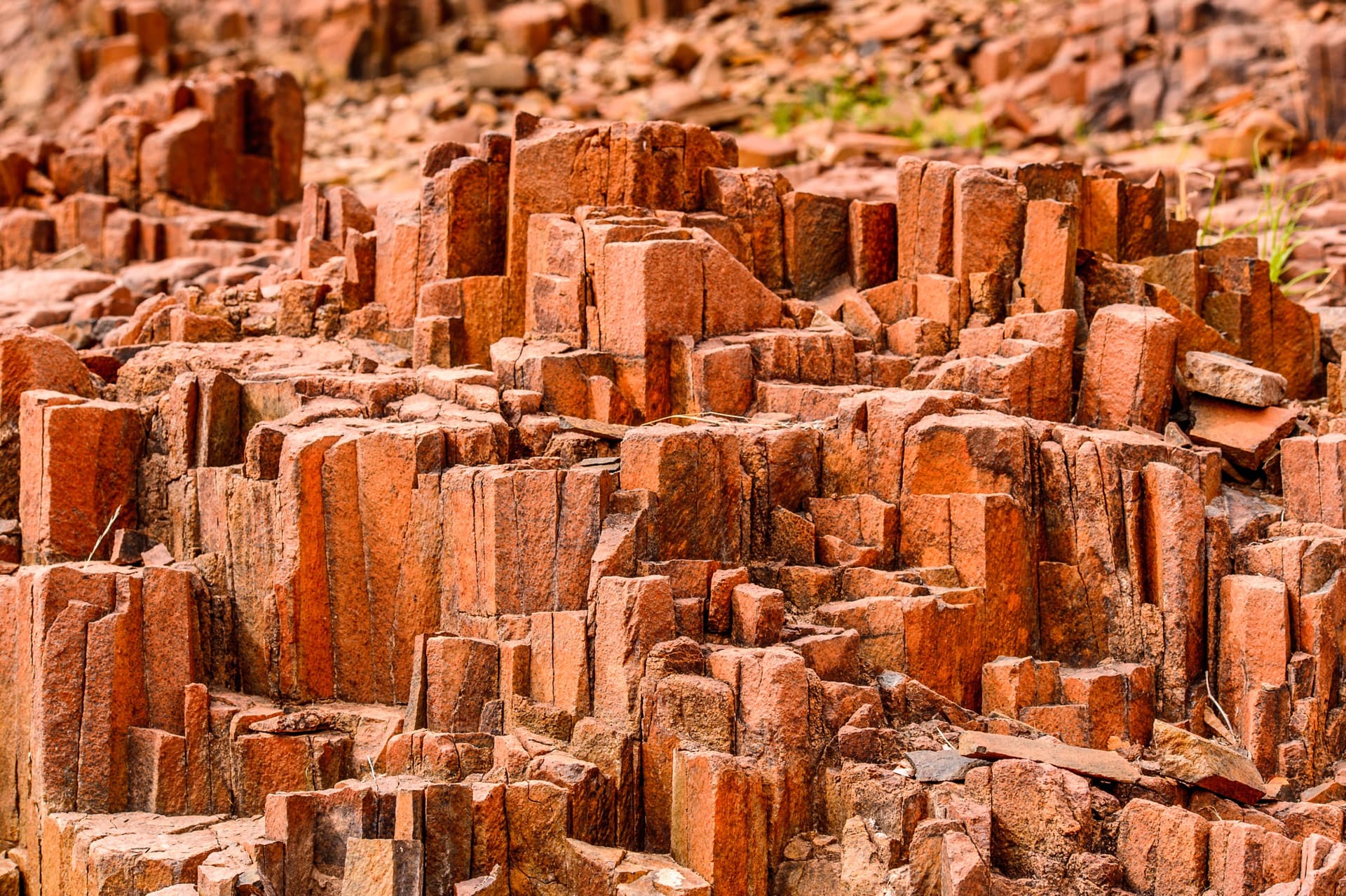
- The Dolerite Organ Pipes: approximately 10 km to the east, these basalt columns fractured into vertical prisms are particularly photogenic at sunset.
- The Petrified Forest: nearby, it preserves fossilized tree trunks over 250 million years old, carried from central Africa by ancient waterways.
- Desert elephants of Damaraland: full-day 4x4 excursions allow you to track them in dried-up riverbeds.
- Further south, the Brandberg massif is home to the famous White Lady painting.
Frequently asked questions
Frequently asked questions
The main circuit takes 1 to 2 hours with a guide. Including nearby sites (organ pipes, petrified forest), allow half a day to a full day.
Yes. For conservation reasons, access to the petroglyphs is only possible with an approved local guide, available at the reception centre.
May to September, during the dry season, when temperatures are more comfortable. Engravings are best viewed early morning or late afternoon.
Yes, Damaraland offers 4x4 outings to observe desert elephants and other species adapted to arid environments, often as a full-day experience.
Several lodges and camps are located within a radius of 10 to 30 km of the site, ranging from camping to upscale lodge accommodation.
Plan your trip
Twyfelfontein fits naturally into an itinerary connecting the Skeleton Coast, Damaraland and Etosha. To build a tailor-made circuit incorporating this site and other highlights of the country, explore our Namibia travel ideas.
Interested in this visit?
We can include it in your personalised itinerary.