Victoria Falls
Victoria Falls
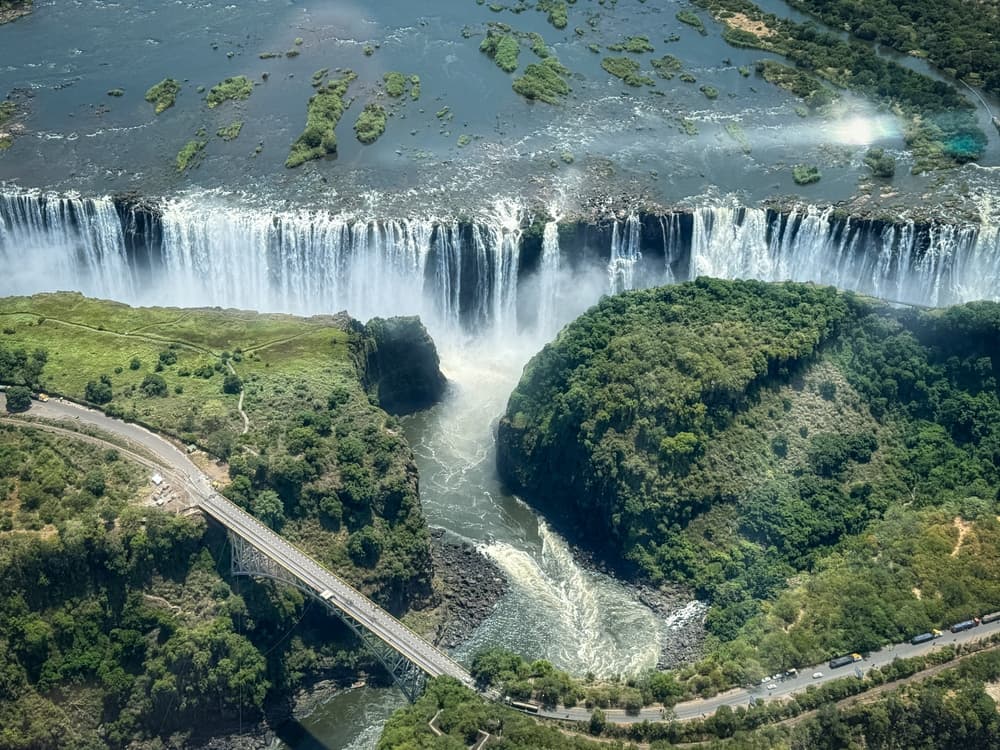
Straddling the Zimbabwe-Zambia border, Victoria Falls plunges over 100 meters in height and 1,700 meters in width. Rainforest Trail, Devil's Pool, Knife Edge Bridge: a UNESCO-listed site to experience from both sides of the Zambezi River.
Victoria Falls cascade at the border between Zimbabwe and Zambia, along the Zambezi River. With a width of approximately 1,700 metres and a height exceeding 100 metres, they form one of the world's largest curtains of water. The roar can be heard for several kilometres, and the cloud of mist that rises is visible from afar. The Zimbabwean town of Victoria Falls and the Zambian town of Livingstone both serve as bases for visiting.
Practical Information at a Glance
Admission: paid on both sides of the border (Zimbabwe and Zambia); rates vary by nationality — bring US dollars.
Best time: February to May for maximum water flow; July to October for optimal visibility and water activities (lower water levels).
Recommended duration: 2 to 4 hours for the viewpoint circuit; allow a full day if combining activities.
What to wear: waterproof jacket or poncho strongly recommended during high-water season — spray will soak visitors completely.
Access: Victoria Falls Airport (Zimbabwe) receives direct flights from Johannesburg and other African hubs; Livingstone Airport (Zambia) is also served.
Accessibility: the Zimbabwean side has some improved pathways, but terrain remains uneven at several viewpoints.
What You'll See
The Zambezi plunges into a narrow gorge in a series of falls divided into five main sections. On the Zimbabwean side, the Rainforest Trail winds through a tropical forest sustained by permanent mist. On the Zambian side, the Knife Edge Bridge offers a frontal view of the main waterfall. In the dry season, the Devil's Pool — a natural pool at the cliff's edge — is accessible for swimming from Livingstone Island.
History and Context
The local Kololo people called these falls Mosi-oa-Tunya, "the smoke that thunders." Scottish explorer David Livingstone described them in 1855 and named them after Queen Victoria. The site has been a UNESCO World Heritage site since 1989, jointly with the surrounding national park. The railway bridge built in 1905 by the British still spans the gorges downstream.
Highlights of Your Visit
The Rainforest Trail (Zimbabwean side)
This marked trail crosses a forest kept verdant year-round by the mist. About fifteen numbered viewpoints dot the path, each offering a different angle on the falls. During high-water season, some viewpoints are entirely shrouded in vapour.
The Knife Edge Bridge (Zambian side)
This suspended footbridge over the gorges places visitors face-to-face with the Eastern falls. The experience is physically intense: the spray is powerful and the bridge vibrates. It's one of the most spectacular angles for photographing the main waterfall.
The Devil's Pool
During the dry season (typically September to December), local guides accompany swimmers to this natural pool formed by a rocky ledge at the cliff's edge. The activity is supervised and reserved for adults in good physical condition.
Victoria Falls Bridge
Built in 1905 for the Cape-to-Cairo railway line, this steel bridge spans the gorges 128 metres above the Zambezi. It is now used for bungee jumping and offers a plunging view of the gorges downstream of the falls.
Photography Tips
Morning light (before 10am) is gentlest on the Zimbabwean side. During high-water season, protect your camera with a waterproof bag or cover — spray damages lenses within minutes. The Zambian side in late afternoon offers raking light across the gorges. A lunar rainbow is visible on certain full-moon nights during high-water season.
Location and Access
The falls sit on the Zimbabwe-Zambia border, approximately 450 km north of Bulawayo and 470 km from Lusaka. The town of Victoria Falls (Zimbabwe) is within walking distance of the national park. The town of Livingstone (Zambia) is about 10 km from the Zambian side. Border crossing between the two towns is possible with a KAZA visa (Kavango-Zambezi), which covers both countries for eligible nationals. Minibus and taxi transfers are available from both towns.
Nearby Attractions
Hwange National Park — Zimbabwe's largest park, about 100 km east, home to one of Africa's largest elephant populations.
Chobe National Park (Botswana) — approximately 70 km away, accessible as a day excursion, renowned for river safaris on the Chobe.
Zambezi Gorges — downstream from the falls, they offer white-water rafting among the continent's most technical rapids.
Livingstone (Zambia) — historic town with the Livingstone Museum dedicated to the explorer and several bush lodges.
Frequently Asked Questions
Frequently asked questions
It depends on your priorities. From February to May, water flow is at its peak and the visual spectacle is impressive, but spray sometimes obscures the falls themselves. From July to October, flow is lower, visibility is better, and activities like Devil's Pool are accessible.
Both sides are complementary. The Zimbabwean side offers more viewpoints and a well-maintained forest trail. The Zambian side gives access to Knife Edge Bridge and Devil's Pool. If time permits, combine both with a KAZA visa.
During high-water season (February to May), a poncho is essential — you will be soaked like under a shower at several viewpoints. In the dry season, spray is far less intense and a simple windbreaker suffices.
The activity is supervised by experienced local guides and is only offered during the dry season, when river flow is low enough. It remains physically demanding and is not recommended for non-swimmers or those with mobility difficulties.
Yes, it's actually one of the most popular combinations in southern Africa. Hwange National Park (Zimbabwe) and Chobe Park (Botswana) are accessible as day excursions or as extensions from Victoria Falls.
Photography is permitted for personal use. Protect your equipment from spray with a waterproof cover, especially during high season. No particular restrictions apply to standard cameras.
Want to discover this destination?
Our local advisors design your tailor-made trip.